 Add to Chrome
 Add to Firefox
 Add to Edge
RoleCDE:Benchmarking and Mitigating Role-Alignment Trade-offs in Role-Playing Agents
Jun 01, 2026
Role-playing agents(RPAs) are widely used to steer large language models(LLMs) toward role-consistent behavior, yet existing benchmarks mainly evaluate surface-level fidelity and offer limited insight into decision making under role-alignment value conflicts. To address this gap, we introduce RoleCDE, the first benchmark designed to evaluate RPAs under structured conflicts between role-specific values and alignment-oriented constraints. RoleCDE formulates role-aware decision making as cognitive dilemma scenarios, jointly evaluating role-scenario grounding, value conflict resolution, and decision tendencies. The benchmark is constructed at scale, covering approximately 8k diverse role profiles and scenarios and nearly 24k dilemma instances across three difficulty levels and eight role categories. Evaluation of several mainstream LLMs reveals a "Role Value Decoupling" phenomenon, where agents systematically default to alignment-and morality-consistent decisions rather than role-specific values when the two conflict, even under explicit role conditioning. This behavior is largely invariant to dilemma difficulty but varies substantially across role categories. We further show that RoleCDE-based fine-tuning effectively mitigates this decoupling by improving value trade-off reasoning, while preserving general role-playing fidelity and general reasoning performance. Code is available at: https://github.com/rabbitrose/RoleCDE.

MemOS: An Operating System for Memory-Augmented Generation (MAG) in Large Language Models
May 28, 2025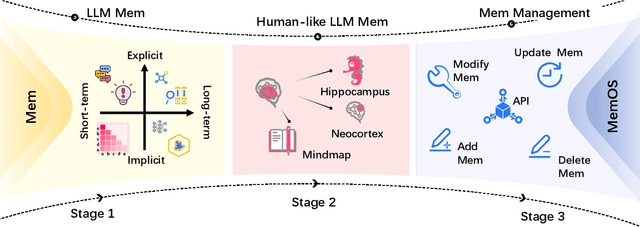
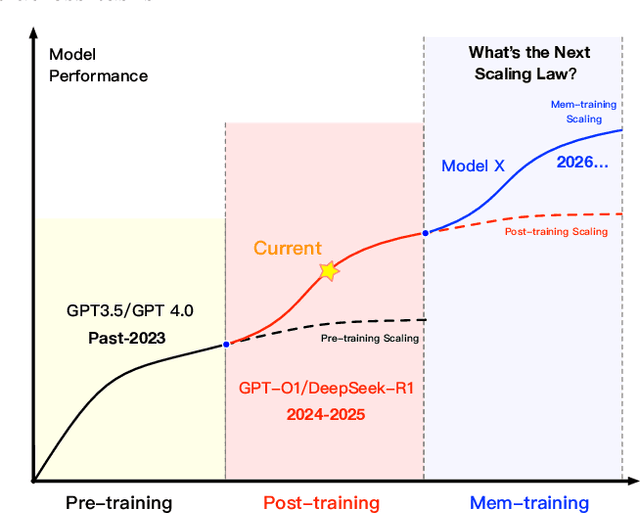
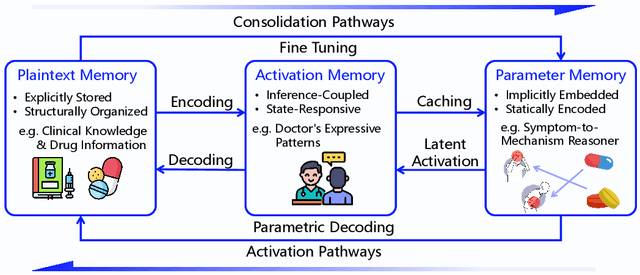
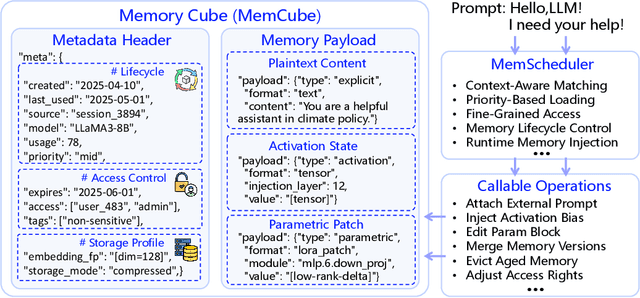
Large Language Models (LLMs) have emerged as foundational infrastructure in the pursuit of Artificial General Intelligence (AGI). Despite their remarkable capabilities in language perception and generation, current LLMs fundamentally lack a unified and structured architecture for handling memory. They primarily rely on parametric memory (knowledge encoded in model weights) and ephemeral activation memory (context-limited runtime states). While emerging methods like Retrieval-Augmented Generation (RAG) incorporate plaintext memory, they lack lifecycle management and multi-modal integration, limiting their capacity for long-term knowledge evolution. To address this, we introduce MemOS, a memory operating system designed for LLMs that, for the first time, elevates memory to a first-class operational resource. It builds unified mechanisms for representation, organization, and governance across three core memory types: parametric, activation, and plaintext. At its core is the MemCube, a standardized memory abstraction that enables tracking, fusion, and migration of heterogeneous memory, while offering structured, traceable access across tasks and contexts. MemOS establishes a memory-centric execution framework with strong controllability, adaptability, and evolvability. It fills a critical gap in current LLM infrastructure and lays the groundwork for continual adaptation, personalized intelligence, and cross-platform coordination in next-generation intelligent systems.
SEAP: Training-free Sparse Expert Activation Pruning Unlock the Brainpower of Large Language Models
Mar 10, 2025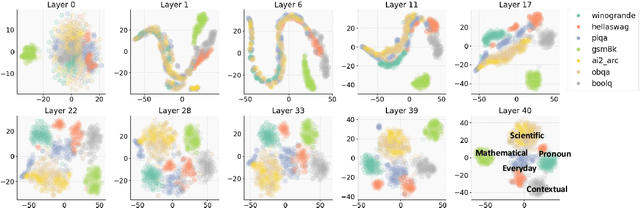
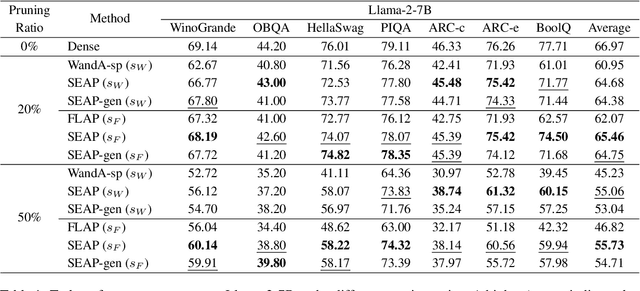
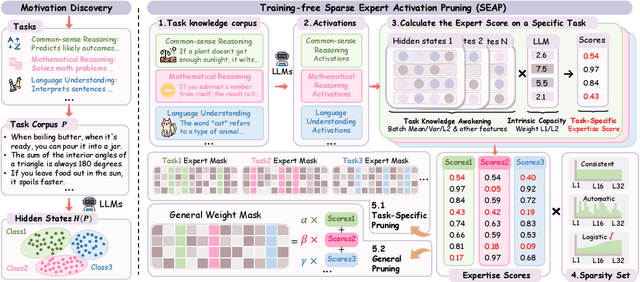
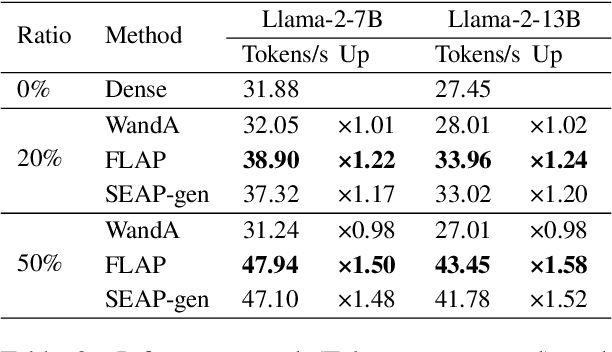
Large Language Models have achieved remarkable success across various natural language processing tasks, yet their high computational cost during inference remains a major bottleneck. This paper introduces Sparse Expert Activation Pruning (SEAP), a training-free pruning method that selectively retains task-relevant parameters to reduce inference overhead. Inspired by the clustering patterns of hidden states and activations in LLMs, SEAP identifies task-specific expert activation patterns and prunes the model while preserving task performance and enhancing computational efficiency. Experimental results demonstrate that SEAP significantly reduces computational overhead while maintaining competitive accuracy. Notably, at 50% pruning, SEAP surpasses both WandA and FLAP by over 20%, and at 20% pruning, it incurs only a 2.2% performance drop compared to the dense model. These findings highlight SEAP's scalability and effectiveness, making it a promising approach for optimizing large-scale LLMs.